


Biology is becoming programmable.
Two compounding technological trends are rapidly democratizing dual-use biotechnology: the cost of bioengineering is falling, and AI models are getting better at biology.
Together, they’re lowering the barrier to engineering bioweapons. It now costs <$100k to synthesize a pathogen, AI models are able to outperform experts on benchwork troubleshooting evaluations, and tools like AlphaFold and Evo2 are changing our ability to understand and engineer biology at will.
AI scales offense significantly faster than defense: the physical infrastructure to defend against biological threats does not scale by Moore’s law, but AI lab assistance and the quality of AI biological design tools might.
We are transitioning into a new regime, one where highly-resourced state actors, as well as unsophisticated and under-resourced actors, may be able to synthesize a pathogen far more dangerous than a natural virus.
Our current defenses are inadequate for this paradigm, and engineered bioweapons present a significant threat. While the interventions to mitigate these risks exist, the teams to research, prioritize, and deploy the infrastructure do not. We believe this is a highly tractable problem.
This article maps the landscape of critical bottlenecks in global biosecurity to provide readers with an understanding of the overarching field strategy. It should act as a blueprint for builders who want to make a difference in this space.
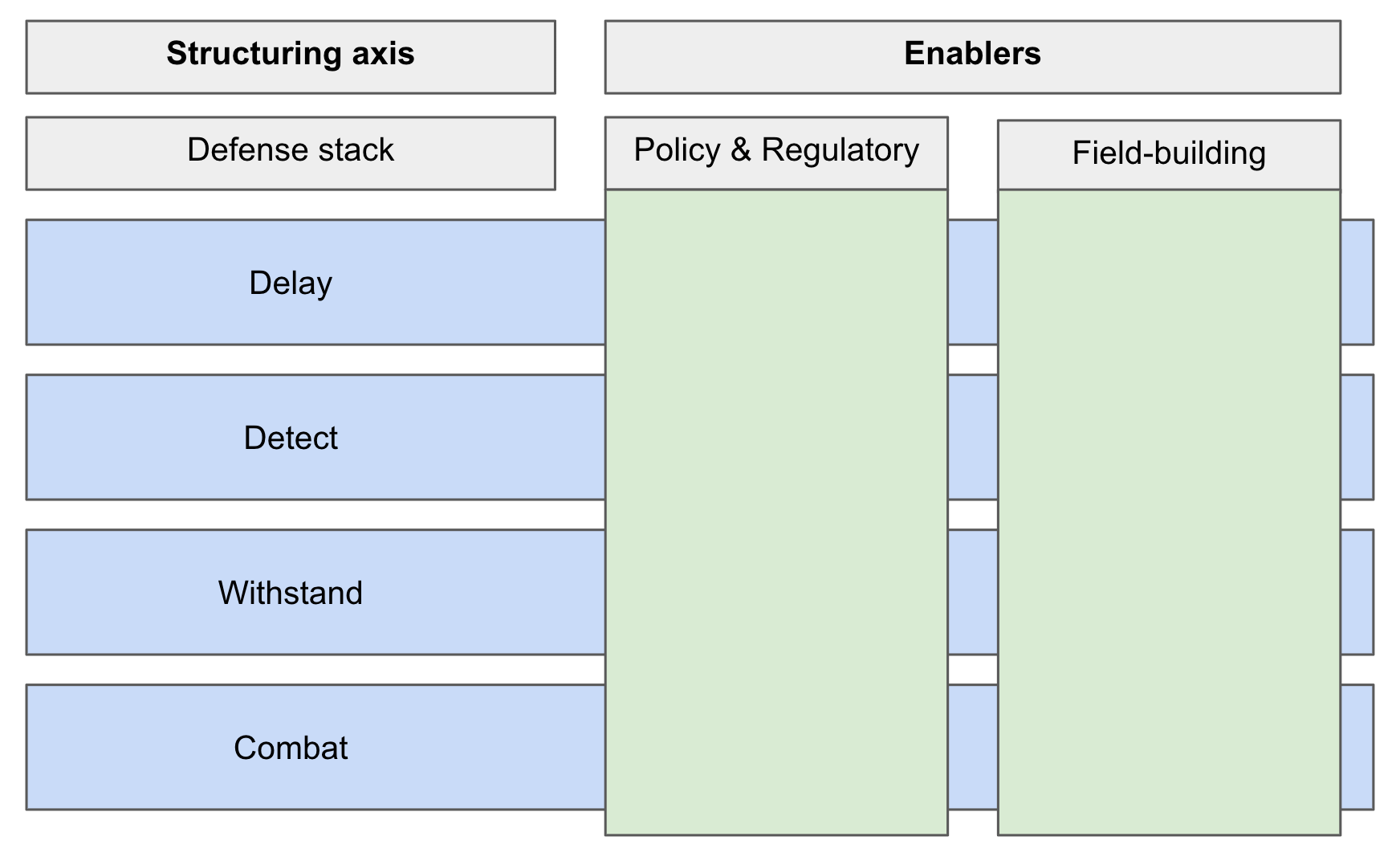
We break down global biosecurity into a stack of defense layers: Delay, Detect, Withstand, and Combat. We have also included two under-discussed enabling layers: Field-building and Policy & Regulatory. These are based on internal research and previously published strategies, such as the Four Pillars Strategy and Delay, Detect, Defend. It is also informed by reports from various governmental and independent bodies, including:
We need a well-resourced ecosystem of talent to build these defense layers in advance of a pandemic event. Massive waves of new philanthropic funding for interventions in these areas will be available to enable this.
The BlueDot Impact team has and will continue to work with experts in biosecurity to publish priority missions. By this we mean well-scoped projects, companies, or organizations that will help pandemic-proof the world. These will be based on deeper strategy work done on each of the defense layers and have funding support from us and others for those who want to build. They will be available here as missions on our website.
We directly support founders looking to build in the space through our Seed Grants program and through introductions to other funders.
Where to Start
On desktop, Substack allows you to click through the table of contents with the bar on the left of the screen.
If you are unfamiliar with the space: Start with the Threat Model.
If you are a builder or generalist: Explore any layer that aligns with your interests or past experience, or read the full stack.
If you are a policy expert: Explore the Policy & Regulatory layer.
If you are a talent expert: Explore the Field-building layer.
If you want to learn more first: Apply for BlueDot Impact’s course on Biosecurity.
If you think you may want to own a mission: Contact the BlueDot Impact team to discuss the highest-priority missions or share your idea.
Brief Introduction: A History of Inadequate Defenses
Pandemics are not a new problem. The 1918 influenza killed an estimated 50 million people, HIV has killed roughly 40 million, and the Black Death killed half of Europe. Bioweapons are also not a new problem, but we have no effective policy in place to stop them.
For example, the 1972 Biological Weapons Convention (BWC) was meant to end state bioweapons programs. While its overall effect may have been positive, it has no oversight or enforcement mechanism.
The international unit responsible for supporting the Biological Weapons Convention runs on a $2.2M annual budget with 4 staff. For context, the average U.S. McDonald’s restaurant takes in ~$4M/year.
As they signed the BWC, agreeing not to build bioweapons, the Soviets concurrently expanded their bioweapons program. The Biopreparat program ran for two decades after the treaty, employing tens of thousands of scientists and weaponizing anthrax, plague, and smallpox at industrial scale. They also built stockpiles of vaccines for their own population.
This historical example is unfortunately representative of the chronic under-prioritization of biodefense. Historically inadequate defenses will become woefully inadequate as we enter a new technological paradigm of AI-enabled, engineered pathogens.
Threat Model
AI-enabled Engineered Pathogens Expand the Space of Potential Threats
It is already possible for a person to use biology to kill large numbers of people. The number of people with this capability is expanding as AI democratizes technology and biotechnology broadly advances. Moreover, the space of potential threats will increase as biological models start to improve. Our primary concern is engineered bioweapons enabled by AI tools and cheaper synthesis technology. These are a new problem, and they are of priority concern over natural pathogens primarily for these two reasons:
→ Democratized Capabilities
AI uplift, the ability of AI to assist in queries regarding benchwork or scientific strategy, will enable increased access to offensive capabilities. Capabilities that were once the exclusive domain of state programs will become within reach of small, under-resourced teams or individual actors. This increases the likelihood of a deliberate attack significantly.
→ Unprecedented Threat Level
AI-enabled bioengineering could bypass the evolutionary trade-offs (between transmissibility, lethality, and environmental persistence) that constrain natural pathogens.
Natural transmissibility and virulence are likely the floor for engineered pandemics, because evolution is not an effective search algorithm. A hypothetical pathogen designed to combine the transmissibility of measles, the lethality of Ebola, and a long asymptomatic or incubation period like HIV could, in a worst case, spread globally and threaten billions of lives.
Our threat model prioritizes bioengineered respiratory viruses because aerosol transmission most enables rapid spread before medical countermeasures can be deployed, but also includes other potential vectors.
It is important to note that defenses adequate to protect against an AI-enabled bioweapon will also be effective against natural pandemics.
Types of Catastrophic Pandemics
By Transmission
Stealth (Human-to-Human): Long asymptomatic transmission and incubation times, spreads globally before detection.
Wildfire (Human-to-Human): High lethality and extreme transmission rates.
Persistent (Environment-to-Human): Pathogens surviving in soil, water, or air.
By Engineering or Deployment Strategy
Evasive: Stacked immune-evasive engineering or other special biochemistry bypasses immunity.
Plural: Attacks with multiple pathogen releases that could overwhelm medical countermeasure supply chains.
Primary Threat Actors
AI-Uplifted Non-State Actors: AI guides less sophisticated or under-resourced actors through pathogen design and synthesis. This includes apocalyptic-type terror groups actively pursuing unconstrained mass-casualty attacks, like Aum Shinrikyo, which attempted multiple bioattacks, including attempting to cultivate both Bacillus anthracis (anthrax) and botulinum toxin during the late 1980s and early 1990s.
State Actors: The main risks are covert program leaks or theft, because it is likely not in a State’s strategic interest to release a catastrophic pathogen. This does not mean intentional release should be fully discounted. Bioweapons allow for plausible deniability because attribution is difficult, making them a potential choice for military action below the threshold of open war. They are also uniquely destructive, propagating in a way no other weapon can, while preserving physical infrastructure, which is useful for an invading force. Additionally, states can work to protect their own population in advance, as the Soviets did during the Biopreparat program by stockpiling vaccines against their own weapons.
Key Strategic Implications
Any catastrophic pathogen must still physically enter a human body and spread worldwide, with some exceptions. e.g. it is designed to attack agriculture.
We are uncertain about timelines, severity, threat actors, and the exact form of threat, so we should prioritize pathogen-agnostic interventions that work across many threat models.
Defense Stack
Delay Patient Zero
The Delay layer interventions prevent dangerous pathogens from being designed, synthesized, or released, and buy time for the other layers to be built.
Frontier AI models are increasingly capable of helping users reason about biology. Biological tools are dual-use, meaning that those which enable better medicines and pandemic countermeasures may also enable bad actors to design bioweapons.
The frontier labs are aware of and concerned about this. OpenAI has concluded that based on their April 2025 Preparedness Framework, upcoming models are expected to reach “High” biological capability. A subsequent CSIS analysis notes that both OpenAI and Anthropic have updated their evaluations to flag substantial and immediate biorisks. SecureBio developed an evaluation called the Virology Capabilities Test, which evaluates benchwork troubleshooting skills, and has run the test at a large-scale with expert biologists for comparison. In April 2025, they discovered that OpenAI’s o3 model performed better than 94% of expert virologists. In a July 2026 pre-release assessment, they found that GPT-5.6 Sol outperformed every expert. They also announced that it was the first model to reliably identify a known way to evade commercial synthesis screening.
Many labs are strict about giving responses to prompts that may be dual-use, but identifying which prompts are dangerous and which are not is difficult. On September 10, 2026, Anthropic published a security report on detecting and countering the misuse of AI, including case studies on potential bio-misuse. The five case studies reported included examples where users outside the US, several linked to military or state-associated labs, used Claude models for inquiries involving chikungunya gain-of-function work, mammalian adaptation of avian influenza, studies on orthopoxvirus immune-evasion, and toxin redesign. Users used elaborate methods to bypass blocks on region access and attempted to obscure their work. Anthropic is known for having the strictest biology safeguards, so it is likely that other labs have seen similar or more concerning inquiries.
At the same time, mail-order nucleic acids are becoming cheaper and more accessible. It cost less than $100,000 to order and propagate an extinct poxvirus of similar size and complexity to smallpox in 2016, and that number is dropping every year.
Benchtop synthesis, where scientists can use machines within their labs to synthesize nucleic acids, is another problem. Market analyses suggest benchtop synthesis capacity could reach 10-20% of total gene synthesis capacity within a decade, creating an available window for those who want to bypass screening. Without integrated screening requirements, this will become a major biosecurity gap in the next several years.
The current systems in place to intervene at the model level or at the point of synthesis are not sufficient, and we do not have good enough evals and threat modeling to understand how good they are or would need to be.
This level of intervention also involves surveillance to monitor potential threat actors and other deterrence methods, but these are largely out of scope as government is best equipped to intervene at that level. We have included some aspects of this that could be worked on privately under “Misuse Reporting and Incident Attribution.”
Model-level Interventions
Prevent AI models from providing biological design uplift to bad actors.
Current approaches (e.g. refusal classifiers, output monitoring) are inconsistent across labs and vulnerable to sophisticated adversarial use. Designing better systems and making them consistent across labs, especially designing better classifiers, assists in preventing these technologies from being used to develop advanced weapons. There may be other interventions at this level that are less related to the models. For example, Know-Your-Customer (KYC) is a system that the financial world uses to understand who is making a particular transaction and evaluate them. An advanced and complex KYC system could enable AI providers with another tool to evaluate the intent of a user. These interventions are ineffective for open-weight models, which are approximately 6 months behind frontier models as of October 2026. This makes these types of interventions lower priority than others.
Synthesis Screening and Other Bioeconomy Interventions
Build the infrastructure to physically prevent bad actors from building bioweapons, like blocking dangerous nucleic acid orders before they ship.
Engineering bioweapons is physically hard, and requires several steps that present defenders with plausible opportunities to disable bad actors. Work here will require thinking about where these opportunities are, and what actions can be taken at each level to ensure that engineering bioweapons remain difficult.
Synthesis screening is an obvious chokepoint, and it is tractable from both a policy perspective and a technical one.
On the technical side, there are several issues. Most companies who screen only screen orders exceeding 200 base pairs. This is a security gap because short fragments that fall below that screening threshold could be assembled into longer constructs after purchase. The quality of this screening is also unclear, especially in the face of an evolving threat landscape where models could help design around detection. According to experts, it is plausible that no company screens properly yet.
At the infrastructure level, building a comprehensive screening system requires work on the screening algorithms themselves and on secure-by-design features for benchtop devices. One critical hurdle here is that it is currently difficult to characterize, from sequence, whether something is a dangerous pathogen or not, unless it matches a known sequence perfectly. This level also requires building an org, or multiple orgs, with an effective business or nonprofit case for everyone to screen.
Misuse Reporting and Incident Attribution
Deter potential bad actors by ensuring they are caught.
There are three reasons an adversary might make bioweapons their weapon of choice: their potential for destruction, ambiguous attribution, and the general offensive advantage. The second reason is a potential chokepoint. While most deterrence work falls on the government side, misuse reporting and better attribution can be, at least partially, worked on privately. Misuse reporting is simple in premise. Relevant companies should monitor consistently for misuse and immediately report concerning incidents to the relevant authorities. There may also be room for work developing better coordination around misuse reporting, including data sharing between relevant providers. (Providers here includes companies along the chain, from those selling nucleic acids to those selling frontier model access.) Attribution likely requires technical innovation. The debate the world saw around SARS-CoV-2 origins is an excellent example of how difficult it is to tell from sequence whether or not something might be engineered, let alone whether it might have come from laboratory samples or not. Research into using all available data to better attribute the source of biological threats is needed.
Evals and Threat Modeling
Develop rigorous methods for assessment of model capabilities, synthesis screening systems, and the potential threat landscape.
Uncertainties about what the main threat vectors are and why could impede the development of proper safeguards. It is currently difficult to quantify the delta in offensive capability afforded to non-expert adversaries leveraging frontier AI models, i.e. AI companies do not have the capability to assert that their AI models won’t improve a bad actor’s ability to build bioweapons. More organizations like SecureBio, which developed the Virology Capabilities Test, are needed to understand the urgency of model-level interventions and which interventions are effective. More organizations are needed to perform wet lab uplift studies.
The efficacy of sequence screening systems against novel or engineered biological designs also requires extensive validation and red-teaming. At the most baseline level, the rapid evolution of the biothreat landscape demands dynamic threat modeling that can anticipate future risk vectors. Resolving all of these uncertainties will give clarity to the entire biosecurity field about what to prioritize. To do this, work must be done to build better evaluations, better threat modeling, and red-teams that can operate securely and effectively.
By threat modeling, we mean considering potential chokepoints and threat actors, not brainstorming novel bioweapons. Threat modeling and red-teaming should not be a priority for those first entering the field. They are both dual-use and require extensive security experience.
Detect Early Infections
In a pandemic scenario, costs compound exponentially with the spread of the pathogen. Every day that passes before countermeasure deployment could mean tens of thousands of lives lost. Detection is the layer that gives every other intervention more runway.
The COVID-19 timeline shows the current system’s failure. The first documented cases occurred in Wuhan in early December 2019, but the sequence was not published until January 11th, 2020. When the WHO declared a public health emergency on January 30th, 2020, the virus was already on four continents. Retrospective wastewater analysis later found SARS-CoV-2 in northern Italian samples from December 18th 2019, nine weeks before community transmission was clinically identified at Codogno (La Rosa et al. 2021). This analysis used PCR designed against a published genome, and was therefore able to provide a sensitivity that current metagenomic surveillance for a novel pathogen would not have. However, it is possible that surveillance technology could be developed to achieve something closer to that level of sensitivity, even for novel pathogens.
If there had been wastewater surveillance approaching that level of sensitivity in Wuhan at the time, we could have added ~1 month of time to develop countermeasures and prepare our critical infrastructure for the outbreak, including distributing personal protective equipment (PPE) to critical care workers and ramping up manufacturing capacity.
If the system is unprepared for a pathogen like SARS-CoV-2, it is completely unprepared for an advanced bioweapon.
Early COVID-19 strains spread with an R₀ of ~3, meaning each person infected about 3 others, while viruses like measles spread with R₀ between 12-18. Advanced bioweapons enabled by AI could spread with extreme infection rates, often referred to as the “wildfire“ pandemic scenario, or they could spread silently, often referred to as the “stealth” pandemic scenario.
Below are three subareas critical to the success of building a system that is prepared for the advanced threats we will face.
Surveillance
Design pathogen-agnostic systems that can sample and read at sufficient scale.
Pathogens designed to spread asymptomatically with long incubation times will be invisible to the current system, which detects pathogens through clinical surveillance.
The current system is set into motion by some threshold of patients seeking care or clinicians noticing unusual patterns, meaning one or more transmission generations have likely already elapsed. If a patient tests negative for known pathogens, their samples are not sent for metagenomic (agnostic) sequencing by default. In fact, their samples are not sent until a clinician decides to escalate after a prolonged period of ineffective standard treatments, worsening conditions, or unusual deaths, giving bioweapon-class pathogens weeks to spread, especially if designed to do so quietly.
To detect advanced bioweapons, a pathogen-agnostic surveillance system must be built. This includes systems to sample and attain data from those samples, most likely through metagenomic sequencing.
Characterization
Develop threat assessments based on available data.
One of the main bottlenecks to pathogen-agnostic surveillance is characterization. If a novel pathogen is spreading, we see it as one sequence among an uncountable number of benign unknown pathogens. It is nontrivial to characterize whether the sequence poses a risk, and Valthos recently raised over $30M from OpenAI, Lux Capital, and Founders Fund partly to solve this problem. It is also a dual-use area because any system that can evaluate how dangerous a pathogen is could also design dangerous pathogens by evaluating generated sequences. This will require strong security and judgement from owners who want to contribute.
Withstand Outbreaks
The Withstand layer is about preventing pathogens from spreading.
The Withstand layer is likely the most important layer to prioritize. The best objectives in this layer are pathogen agnostic, which means working on this prepares us for a broad variety of threats, including threats we have no model for. Many of these defenses do not require that we know there is a pathogen spreading, which makes them especially important for stealth pandemics.
The Withstand layer is also the most durable. In the case where a threat actor plans a multi-wave attack, Combat-layer tools degrade in each wave as stockpiles deplete and the system runs out of basic materials. Withstand-layer infrastructure depletes at a much slower rate. Some Withstand-layer interventions, like infrastructure hardening, could last indefinitely.
Work within the Withstand layer spans Respirators, Infrastructure Hardening, and Social Interventions like lockdowns and proper messaging. Infrastructure Hardening as a subarea has multiple potential pathways, with many organizations working on strategies to engineer the environment so that buildings and vehicles are inhospitable to pathogens.
Hadrian, led by Connor Campbell, is currently owning some of the non-pharmaceutical interventions (NPI) and Infrastructure Hardening subareas for the United States.
Respirators
Reduce transmission via respirators.
Respirators are the most reliable PPE in every scenario where airborne transmission is the primary route of infection. Properly-fitted respirators protect critical workers, allowing healthcare systems and the industrial base to continue operating during a pandemic. This is important during the window before medical countermeasures become available and may be integral to being able to manufacture and distribute those countermeasures.
The work here includes the underlying technology like materials and fit, the manufacturing base, stockpiles, and distribution systems to ensure respirators are available for critical workers as supply chains break down.
Infrastructure Hardening
Engineer the environment so that buildings and vehicles are inhospitable to pathogens by default.
Infrastructure hardening makes it safe to breathe the air where people gather without risk of pathogen transmission through engineering interventions that operate continuously or that can be turned on in a pandemic scenario. Most pathogens with pandemic potential are airborne, and most transmission happens indoors, but hardening should also take into account environmental to human transmission through the air and other potential vectors, like soil.
There are several possible approaches. High-efficiency air filtration works by filtering out pathogens constantly. Far-UVC lighting (which inactivates pathogens using wavelengths of ultraviolet light safe for human exposure) kills pathogens in the air and on surfaces. Positive-pressure designs help slow environmental to human transmission by preventing contaminated substrate from entering a given building or vehicle. There is also the broader project of “DIY biohardening” to make it possible for households to harden their own spaces.
The technology for all of these approaches exists. The need is for owners to test which approaches are most viable, deploy them, and ensure there is incentive to harden infrastructure now, instead of waiting for the pandemic.
Social Interventions
Coordinate social actions and messaging that limits transmission.
Social interventions include lockdowns, contact tracing, and behavioral guidelines that reduce opportunities for pathogen spread. These measures are especially relevant early in a pandemic. Work in this area will involve research into when and how lockdowns are effective, improving contact-tracing systems, and research on what messaging is most effective at both reducing transmission and maintaining trust.
Diagnostics
Enable social interventions like lockdowns and contact tracing.
We can prevent sick people from infecting others if they stay home when they know they are sick. For this to happen, we need diagnostic tools to accurately ascertain infections. These may be undervalued tools in the biosecurity zeitgeist relative to their importance. Work in this area involves improving pathogen-agnostic diagnostic technologies, specifically towards developing tests that are rapidly reconfigurable, deployable, and report results quickly.
Combat with Medical Countermeasures
Combat is the offensive layer, encompassing everything relevant to neutralizing the pathogen inside human bodies or in the environment. In a scenario where the Withstand layer is fully functional, it is what will allow us to return to a functioning society. In a scenario where the Withstand layer is minimally viable, it is the only thing that can save lives after a pathogen is released.
There have been massive improvements in the field over the last several decades, especially when it comes to programmable vaccines and antivirals. The SARS-CoV-2 vaccine was designed in two days without the help of AI, enabled by prior research on SARS-CoV-1 and MERS. With the aid of AI, it has become possible to design a vaccine even for a novel pathogen in a matter of days.
Against a wildfire pathogen or a stealth pathogen that has been spreading silently for months before detection, we need countermeasures that already exist or can be produced nearly instantaneously from a standing platform. That means they either have to be pathogen-agnostic, like universal vaccines, or built from a trusted platform that can adapt to any pathogen, like mRNA or monoclonal antibodies. Red Queen Bio and Valthos are both working to make programmable medical countermeasures possible.
Trials, manufacturing, and distribution remain bottlenecks without dedicated owners in the biosecurity case, and speed is the largest concern. Novel pathogens may also have stacks of techniques for immune evasion, which means basic immunology research must remain a priority. Work in this layer involves all of the above, as well as developing better policy to support the layer and adequate stockpiling and distribution systems.
Much of the work in the layer is dual-use. It is critical that owners have an operational security mindset.
Prophylactics
Immunization tools and platforms that protect populations from novel pathogens.
Prophylactics like vaccines are estimated to have saved over 150 million lives over the last 50 years. A working vaccine deployed at scale is one of the only things capable of ending an outbreak. Because pathogens spread exponentially, every day that passes without deployment could mean tens of thousands of lives lost.
There are several areas of improvement to the modern vaccine platform that could make a difference in pandemic preparedness. Namely, better formulations and form factor for distribution, like thermostable formulations and needle-free patches, alternative platform development like self-amplifying RNA or prophylactic monoclonal antibody work, better adjuvants, useful correlates of protection, vaccines that work against immune evasive techniques, platforms that can respond rapidly to unknown pathogens, and making broader and more universal vaccines.
It is also important to think about prototype vaccines for high-risk pathogen families. SARS-CoV-2 was a best case scenario in terms of vaccine design because we already knew what antigen to target. The Coalition for Epidemic Preparedness Innovations (CEPI) is currently working on this.
Therapeutics
Platforms that actively neutralize a pathogen when a patient’s immune response is insufficient.
Therapeutics like antivirals are the only current countermeasure that can help someone who has already been infected. Broad-spectrum antivirals may offer more pathogen-agnostic coverage, which matters enormously when the pathogen is novel, and they may be available immediately in a pandemic scenario.
The work here includes developing broad-spectrum antivirals that target conserved viral machinery (polymerases, proteases) and anything that aids rapid-response monoclonal antibody platforms, which are fast to design against a novel target but currently hard to manufacture cheaply at scale. It also includes drug-repurposing pipelines that can screen existing, approved compounds against a novel pathogen.
Basic Research
Scientific research that makes countermeasures against advanced bioweapons possible.
Every countermeasure tool that exists today is based on basic research. The mRNA vaccines deployed in 2020 depended on basic research from the 1990s and 2000s. The antivirals we have against coronaviruses depended on prior structural biology research. Underinvestment in basic research now is underinvestment in the countermeasures available in the next pandemic, and it is especially underinvestment in countermeasures for the most advanced of threats.
The work here includes research on representative members of high-risk viral families, immunology research to support an understanding of how to gain immunity against immune evasive viruses, and how to make countermeasures cheaper.
Stockpiling & Distribution
Pre-position pathogen-agnostic medical countermeasures and manufacturing components (precursors, syringes) and ensure countermeasures are distributed rapidly in a pandemic scenario.
This subarea is about the work between making medical countermeasures (MCMs) and getting them to those who need it, and is largely focused on agnostic infrastructure required to manufacture and distribute MCMs. This includes components like syringes, vials, cold chain infrastructure, fill-finish capacity, and the skilled workforce. COVID demonstrated major gaps in these supply chains, especially in fill-finish capacity and cold chain infrastructure.
The work here includes maintaining stockpiles of critical components and building better infrastructure, including software that better enables coordination between countries and factories. This subarea is less of a priority because it assumes everything else goes well.
Field-building
The Field-building layer creates the conditions under which all the other defense layers get built, funded, and staffed.
Historically, biosecurity has been understaffed and underfunded. The biosecurity policy world has struggled to get legislation across the line. Pandemic preparedness funding typically peaks after an outbreak and collapses within years. No government has prepared for the threat we now face with AI-enabled bioweapons.
The field is tiny relative to the threat –– the number of people globally working full-time on catastrophic biological risk and preparedness is on the order of a couple hundred people. All of them could fit comfortably on a basketball court.
Success for this layer means making biosecurity a field that is well-resourced, well-staffed, well-regulated, and politically resilient.
Talent, Coordination & Ecosystem
The people, organizations, and network the field needs to grow.
Biosecurity is more bottlenecked on talent than on ideas or funding. There are more good interventions to build than people qualified and motivated to build them, and the pending influx of funding is likely to leave funders struggling to find suitable grantees and investments. The field also lacks some of the talent sources that more mature fields take for granted, like relevant conferences and college students who know this is a possible career path. A talented person who wants to build in AI safety has a much clearer pathway than the equivalent person in biosecurity.
The current landscape in this subarea includes BlueDot Impact’s Biosecurity course and career transition grants, the Horizon Fellows program, and the Emerging Leaders in Biosecurity Fellowship (Johns Hopkins). Work in this area includes building or scaling programs that bring new people into the field and building networks that let people find each other.
Economic & Industrial Base
Make sure that we can build, manufacture, and deploy at scale in a crisis.
Many of the interventions in the other defense layers ultimately have to become real products and infrastructure, such as synthesis-screening services, far-UVC, respirator stockpiles, or MCMs. This requires building a functioning operational ecosystem, including capital, suppliers, procurement, and distribution.
The work here consists of building companies that can make research-level interventions deployable, creating better demand-side conditions (government procurement, advance market commitments), and investing in warm-base manufacturing capacity. It could also include thinking about how to make large-scale industrial base pivots in emergency scenarios.
Narrative & Political Economy
Make it politically and socially salient to take biosecurity seriously.
Because the government is such a large funder and new talent is sourced from the public, plausibly the biggest blocker on most of the defense stack is public support, namely, narrative and political economy.
The public’s willingness to act against a threat that hasn’t materialized yet has always been small. Now, the dominant narrative in many countries has soured on pandemic preparedness. Mask-wearing has become a statement of political alignment, as has lab-leak discourse, both things which should have nothing to do with political alignment. Without a healthier narrative environment, good policies and important funding will get cut, and fewer people will choose to work in the field.
The work here includes producing persuasive, credible public communication about why engineered pandemics are a serious risk and building durable bipartisan coalitions. Some of this is journalism, some is online content creation, some is think tank work, some is policy lobbying, and some of it may be ideas our team has not considered.
Policy & Regulatory
Policy: Delay – Interventions
Mandate oversight at the design and bioeconomy levels.
Delay layer interventions work best when they are adopted by ~all actors (e.g. AI companies and DNA providers).
On the bioeconomy side, there are several interventions that need work.
It is unclear what level of government monitoring of the bioeconomy would be sufficient to deter a threat actor.
Voluntary synthesis screening leaves a gap of companies that do not screen, which a determined actor will route through. The willingness is there. The International Gene Synthesis Consortium is an industry group whose members have agreed to voluntarily check incoming orders. It represents the majority of global commercial long gene synthesis capacity. Strong support has also been demonstrated recently through an open letter in support of mandated gene synthesis screening, which was signed by leaders from providers like Twist Biosciences and Ansa Biotechnologies. The letter was also signed by the heads of nearly every frontier AI lab, including Demis Hassabis from Google Deepmind, Sam Altman from OpenAI, and Dario Amodei from Anthropic.
Currently, however, there is no oversight mechanism to ensure that providers are fulfilling screening requirements, nor to block screening evasion techniques like split-ordering. US federal synthesis-screening policy is currently fragmented and specific only to projects receiving federal funding. NIH-funded researchers may only purchase from providers adhering to the 2024 OSTP screening framework, but the administration has ordered that framework replaced and has not yet issued its successor. It is also possible that state governments can act here. On October 1, 2026, California became the first jurisdiction to require screening on routine synthetic DNA orders.
On the model side, AI lab safeguards are voluntary and concentrated in the US, meaning they do not reduce risk from other vectors, like open-weight models developed in other countries. This leaves us vulnerable to biological misuse, especially by foreign actors. Organizations like CAISI who can evaluate models for biological risk to better inform what standards should be in place, if any, are underfunded.
Policy and regulation, especially via international coordination, can close these gaps. The work here includes mandating synthesis screening for all providers and benchtop equipment, evaluating options for biological data governance, setting screening standards, mandating KYC requirements, exploring other policy-relevant bioeconomy interventions, international coordination on safeguards, and liability frameworks that incentivize without deterring innovation. We should also take advantage of foreign actors using US frontier models and mandate that AI providers share relevant threat intelligence with the government.
Policy: Delay – Prevent Immune Evasive Biologies, Mirror Biology
Prevent development of novel immune evasive biologies, particularly mirror biology.
There is another important role for policy to play in the Delay layer: preventing the development of novel immune evasive biologies. Work must be done into understanding the best shape of governance for gain-of-function research, as well as regulation around unusually high-risk biology, such as mirror biology research.
Mirror biology refers to the study and design of organisms whose chirality is inverted from all natural organisms on earth. Chirality is a geometric property of molecules that makes them different from their own mirror-images, and all known life forms have a consistent chirality for organic molecules. The two mirror-image forms are conventionally labeled L and D. For example, proteins are built almost entirely from L-amino acids, while DNA and RNA use D-sugars. All immune systems on earth have evolved to respond to bacteria of natural chirality, and it is likely that no organism would be able to adequately defend itself against a mirror bacterium.
Because of this, there is a strong scientific consensus that mirror biology research towards the development of mirror life poses a significant risk to mankind. However, there is no international policy preventing further research, particularly policy regulating important technological precursors towards developing mirror life like the construction of a mirror ribosome, and there are still scientists working on these precursors. Without policy in place, this biology remains a potential catastrophic risk to mankind.
More information on this can be read here: Technical Report on Mirror Bacteria Feasibility and Risks and Science Paper. The Mirror Biology Dialogues Fund is currently the only organization working full time on this.
Policy: Detect
Use policy and regulatory tools to set up a global system that moves quickly from detection to action.
A sequence acquired through sequencing and deposited in the Global Initiative on Sharing All Influenza Data (GISAID) database does not trigger a response automatically. Public health and intelligence communities each hold only partial pieces of the larger picture, and there is no coordination system tying together the steps from surveillance sample collection to declaring a public health emergency.
Work in this subarea will mean developing proper policy and regulation that can change this, enabling fast coordination that allows us to know when an outbreak has begun. It also includes the harder question of how to handle dual-use characterization data that must be used to enable detection.
Policy: Withstand
Policy that builds government support for the Withstand layer.
The work here includes stockpile policy that addresses gaps in strategic respirator reserves, as well as advocacy and research that supports government adoption of, policy requirements, or funding support for infrastructure hardening. More specifically, policy towards sustainable funding for day-zero SNS reserves of respirators and MCMs, increasing manufacturing capacity, encouraging large-scale HHS trials of novel air-cleaning technologies, and making evidence-based updates to ASHRAE 241.
Policy: Combat
Build policy and regulatory infrastructure that accelerates countermeasure timelines and enables funding of the Combat layer.
Policy and regulation determine how fast a countermeasure moves from design to deployment. The longest piece of the timeline puzzle for vaccines and antivirals is the regulatory component.
Promising work in this subarea includes platform pre-approval, beginning with formal platform designation for mRNA, so approval builds on prior validation of the platform. It may include developing threat-tiered evidence standards that are codified in advance, decreasing the subjectivity involved and the time required to make decisions about what standards to set in an emergency scenario. Validated correlates of protection for high-risk pathogen families may enable immunobridging studies that allow immune markers to count as efficacy data rather than waiting for people in a trial to get sick. Work getting challenge trials more accepted so we can get efficacy data without waiting on community transmission is also useful. It may even be possible to work on compressing the regulatory approval timeline without working on policy, like using AI to develop software that can give regulators meaningful information on safety and efficacy.
Policy: Field-building
Policies and regulation that disable threat actors and enable good actors to pandemic proof the world.
Many of the interventions in the other defense layers require policy action. Synthesis screening must be mandated, KYC requirements for AI biology tools must have oversight, MCM pathways must be improved, etc. They may require legislation or IR/treaty work. These are listed within the layers they support.
There is also broader policy and regulatory work to be done that includes effort towards increasing funding support from the government for biosecurity, supporting academic and think-tank work that gives policymakers analysis to act on, talking to founders and understanding what regulatory changes they need, and developing better international coordination/relationships.
Join the Effort to Pandemic-proof the World
The rise of programmable biology and AI-enabled pathogens make the intervention strategies mapped in this blueprint deeply urgent. Immediate action from exceptional talent is required to protect the world in this new paradigm.
If you think this might be you, here are the best next steps:
Learn More: Apply for BlueDot Impact’s course on Biosecurity to learn more about the space.
Find a Mission: Explore scoped missions on the BlueDot Impact Missions page. Funding for missions will be provided through the Seed Grant program.
Connect with the Team: Contact the BlueDot Impact team to discuss the highest-priority objectives or share your idea. Send context to: Olivia Scharfman at olivia@bluedot.org.
Secure Funding: If you are transitioning your career to work on this type of risk or another critical area for AI safety, apply for a BlueDot Career Transition Grant today.