

Exec Summary
I put this together because I care deeply about the experience participants and facilitators have in our programs, and because over time I’ve developed a lot of takes on how to make sessions go well.
This post is intended to give new facilitators a concrete sense of how they can support their group discussions and a starting point from which they can iterate while developing their own style. Participants can use it as a preview of how sessions run and how to prepare and engage.
TL;DR: Make deliberate choices on how you want to facilitate and be explicit about those choices right from the start. When participants know that your primary goal is for them to learn as much as possible and they know how you are planning to make that happen, they tend to be a lot more okay with you setting and enforcing rules.
Do this before every session
Send a reminder
Send a reminder about pre-reads and exercises two days before each session. Ask participants which sub-exercises they are preparing so that the group covers different deep dives rather than everyone doing the same one.
Skim before reading
Before doing the pre-reads, skim the session plan Google Doc to understand the session arc and exercises.
Take notes as you read
While going through the pre-reads, annotate your personal copy of the session plan. Carry the most interesting quotes and open questions into the group discussion doc in the days before the session. Encourage participants to do the same, so that by session start the “What did you learn?” and “Your open questions” sections are already populated. Use the first few minutes of the session for participants to add comments on what others have written.
Prepare the “correct” answer
Write your own answers to the session exercises beforehand and refine them after the session. Having a worked-out answer as a benchmark makes it much easier to challenge participant responses constructively, rather than evaluating them cold.
Join session early
Join the call 5 minutes before the start. That gives you some extra time to connect with participants who join early and to catch tech issues (which still happen to me on my thousandth Zoom call).
In both my intro and my reminder messages, I encourage participants to also join 5 minutes early, so that we have more time to chat.
Aside from that, I find it generally helpful for everyone to join at least 1 minute early, so that we can start the session on time.
Communicate this in the first session and enforce it
At the first session, introduce the following norms. I frame them as defaults that have worked well in my previous facilitations. I also emphasize that I care deeply about creating an atmosphere in which participants can learn as much as possible and that if some of the rules do not work for us, we can adjust together.
(!) Onboarding
Spend time in the first session explicitly making sure everyone understands how the course hub and the shared Google Docs / calendar invites work. Do not assume this is self-explanatory, I had participants tell me they did not know how to access the course hub in session 3.
Course defaults
Cameras on.
Microphones unmuted. This makes discussions more dynamic because people can respond immediately. Tell participants you will mute them if they have disruptive background noise (but that they can of course unmute as soon as that noise is gone or if they want to say something).
Note: In some groups (due to e.g. echo) that does not work and it is better to have the default be muted.Hand-raising for turn-taking. In an ongoing discussion, ask participants to raise their (virtual) hand so you can call on people roughly in order. Let the group know you will sometimes prioritize someone who has not spoken yet.
Note: If your group is great at self-moderating you can also go with an open-mic format. In my experience, this works best for groups with small connection delay.
Expectations around session preparation
I expect participants to join prepared, but sometimes things come up in their day job / private life and prevent them from doing the pre-reads and exercises. My ranked preferences are for participants to
join mega prepared, i.e. having read the main + optional resources and having done extended thinking on the exercises (+ possibly having sparred with the LLM of their choice). If that does not work to
join prepared, i.e. having read the main resources + spent 15-30 min on the exercises so that they can at least explain their deep dive in the paired sessions (likely using their notes)
reschedule before the session. If that does not work to
proactively flag at the beginning of the session that they are not prepared and then reschedule
Previously, I had unprepared participants sit in as silent listeners and stressed that they come prepared for the next session. However, my experience has been that this is still disruptive to the session and that participants often turn up unprepared again.
Therefore, my new defaults is to
2 days before, remind participants to prepare, and note that anyone who cannot should reschedule.
after the silent updates, ask whether anyone has not managed to prepare. If so, kindly ask them to reschedule, and to Slack you what got in the way and whether there’s anything we at BlueDot could change to help
Expectations around session setting
Participants should join from a laptop or PC with a stable internet connection and camera. If a participant cannot meet this, the default is to reschedule the session rather than run it under poor conditions.
Participants should join from a setting that minimizes disruption to their course participation, e.g. not while in transit or from a space where they can’t speak openly
Keeping contributions concise
My procedure if someone goes long (which I explain to participants in session #1):
After roughly 1–2 minutes, raise my (virtual) hand. This signals that I expect them to wrap up in the next two sentences or 30 seconds, whichever is shorter.
If that does not work, I step in, briefly summarize their point, and pass to the next person.
Time keeping
Start the session timers that are integrated in the Google doc. I sometimes change those on the fly, if a discussion goes particularly well. Use them as a guide for yourself and the participants, but be flexible.
Breakout rooms
While setting up the breakout rooms, let participants know that you will be jumping through the rooms muted and that they do not need to acknowledge you / involve you in their discussion. I usually jump through the breakout rooms quickly in the beginning to check if every group has started their exercise and then stay longer in rooms with interesting discussions.
Wrapping up sessions
Pick deep dives for next week’s session
If next week’s session includes an exercise where participants prepare one of several options, have them divide the options among themselves at the end of this session. That ensures that everyone comes with a different deep dive prepared rather than all covering the same one.
Asking for feedback
I regularly ask participants for feedback. I always paste my anonymous feedback link into the Reflection box: “As always, happy to take (anonymous) feedback”
For urgent or particularly relevant feedback, add a comment and @ me so that I can find fixes
Slack templates
My intro to groups
Hi everyone I’m Chris, I will be your facilitator for the next couple of weeks. I am very much looking forward to meeting you all next week! In the meantime feel free to reach out here in case you have any pressing questions.
Some context on myself: I’m a medical doctor by training, worked as a management consultant for 1.5 years and am now pivoting back into biosecurity work. Generally excited about promoting flourishing and contributing to a more awesome future.
I enjoy mid-distance running, meditating and the occasional session of D&D.
Before our first session, please take five minutes to briefly introduce yourselves here in the Slack. I would love to hear about:
your background
how you got into biosecurity
how you like to spend your free time
anything else you would like to share (great books, podcasts, ideas,..)
I will join 5 minutes early, feel free to do the same! That gives us a bit more time to chat while everyone arrives.
See you soon!
Reminder
Hi everyone - just a quick reminder to complete the pre-reads for {Tuesday’s} session and to use the Learnings and questions section in the session 2 {add the link to the section} tab to take notes (I tend to forget what I found most fascinating when I first read an article).
To avoid that everyone prepares the same intervention for tomorrow’s session, please briefly let the group know which one you picked:
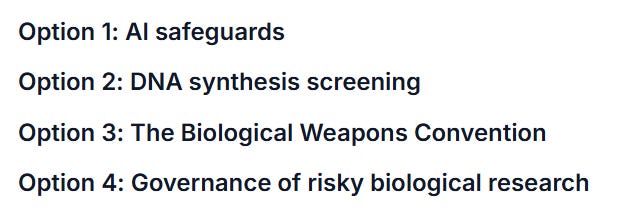
As always, I will join 5 minutes early, feel free to do the same! That gives us a bit more time to chat while everyone arrives.
Looking forward to it!
Acknowledgements
Thanks to Joshua Landes, Li-Lian Ang, Moeen Hosseinalipour, Will Saunter for commentary on earlier drafts. All mistakes are my own.
This is super helpful. Thanks for sharing.
Thanks for sharing. This is great!