


We’ve just updated our salary policy. When doing this, we found surprisingly few simple, publicly-available examples that work for companies of our size. PostHog’s was by far the best we came across, and we have learned a bunch from them.
This page is primarily for current and prospective BlueDot employees, but in the spirit of “public by default”, and because we want others to be able to borrow from our work, we thought we’d publish it here.
What is the goal of our salary policy?
To recruit, retain, and motivate the people required to achieve our mission, within our budget.
What does this mean more specifically?
We want to compete on pay with other orgs and jobs that are hiring from similar talent pools.
Exceptional people should never decline a BlueDot job offer or choose to leave primarily because of pay.
We don’t promise generational wealth (e.g. competing with AI company salaries and equity). The main sell for BlueDot is an exceptional mission, team, culture, high autonomy and responsibility, interesting work and room to grow.
We want the salary policy to be simple, transparent and fair.
Everyone understands how the salary policy works and how their salary is set.
Everyone doing similar work at a similar level in the same place is paid a similar amount.
Hiring managers are able to use the salary policy to quickly and easily set a salary range when hiring for a new role.
Salary calculator
Use our salary calculator to see what any role at BlueDot pays.

Definitions: the different components of our salary policy
How is salary determined?
Your salary band is determined by the type of work you are doing (job family), the seniority and scope of your role (job level), and your location.
Where your exact salary sits within your salary band is determined by your performance in the role.
What is a salary band?
Salary band: The range of potential salaries shared by all jobs of the same family and level in the same location.
Job families: Jobs that do similar ‘types’ of work, for which we will be hiring from a similar talent pool.
Job level: The seniority and scope of a role.
Location factor: The multiplier we apply to San Francisco salary bands for other locations.
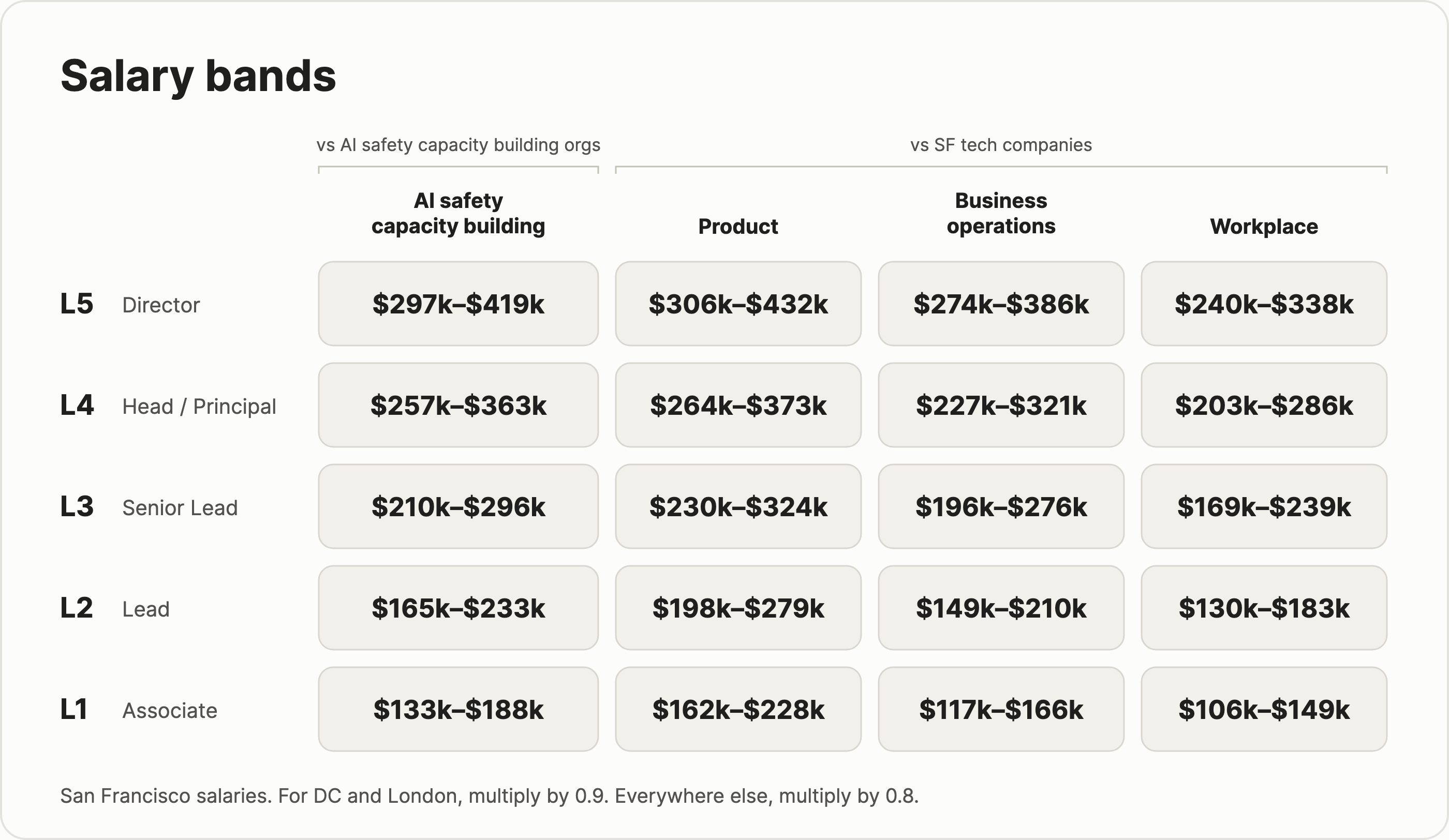
Why have salary bands?
Standardisation: so that people doing similar types of work at a similar level in the same place have similar salaries.
Speed: so that when we open a new job, we don’t need to redo salary benchmarking against external roles every time. We just decide which family and level it is, and this determines the salary band.
How do we determine your exact salary within your salary band?
Reference point: What we pay someone who is fully proficient in the role and consistently meeting expectations.
Compa-ratio: Your salary as a fraction of the reference point.
Step: The section of the salary band that your salary sits in. Dependent on your performance in the role.
Hiring range: The part of the salary band we advertise in job ads and usually hire into: 0.85 to 1.00 compa-ratio, which is the bottom of the band up to the reference point.
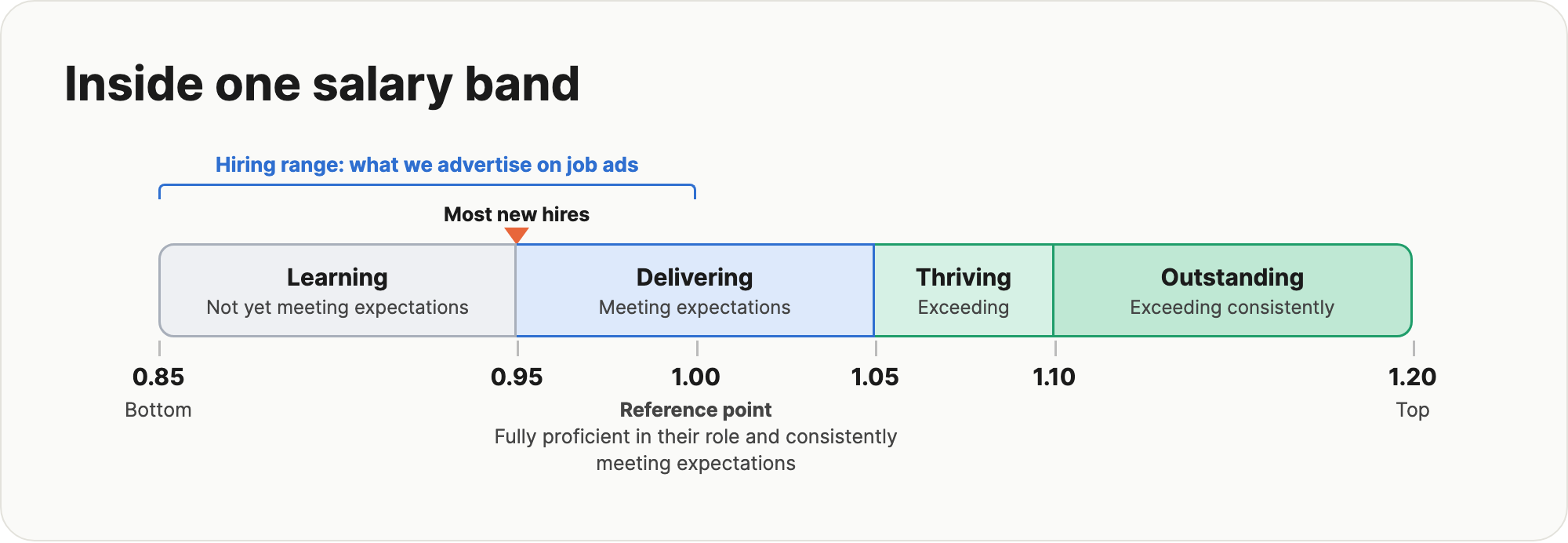
The salary band runs from 0.85 to 1.20 compa-ratio and is split into four ‘steps’. Your step reflects how you are performing in your role:
Learning (0.85–0.94): Not yet meeting expectations
Delivering (0.95–1.04): Meeting expectations
Thriving (1.05–1.10): Exceeding expectations
Outstanding (1.11–1.20): Exceeding expectations consistently
We advertise the hiring range (0.85 to 1.00 compa-ratio) on the job posting, rounded to the nearest $5,000.
We hire most people at roughly 0.95 compa-ratio, the bottom of the Delivering step. They meet expectations but are still growing towards full proficiency in the role.
If someone has more work to do to become proficient at the role and we’re taking a bet on them, we offer them a lower starting salary (e.g. 0.90 compa-ratio, in the Learning step).
If someone has already shown all of the skills required to do the role over an extended period of time, we offer them a higher starting salary (e.g. 1.00 compa-ratio).
We round salary offers to the nearest $1,000. All rounding happens at the very end, for the job ad and the offer. Until then we keep the exact numbers. If you’re paid in another currency, we convert first and then round.
We review pay twice per year. Each time we:
Adjust the salary bands in line with the market.
Adjust your position within your band based on performance (i.e. adjust your step and compa-ratio). See how we review pay for more details.
Why have a ‘hiring range’ at all? Why not just put the entire salary band on a job ad?
It is good expectation-setting for when we make offers. If we advertise the full 0.85-1.20 band and then offer someone 0.95, this is more disappointing than if we advertise 0.85-1.00 and then offer 0.95.
California law says that the advertised range should be “a good faith estimate of the salary or hourly wage range that the employer reasonably expects to pay for the position upon hire”.
Job families
We have four job families (jobs that do similar ‘types’ of work, for which we will be hiring from a similar talent pool).
AI safety capacity-building: Courses, programs, grants and talent work. We benchmark against other top tier AI safety capacity-building orgs (e.g. Coefficient Giving, Kairos and Constellation).
Product: Engineers, product managers and designers. We benchmark against SF tech companies.
Business operations: Finance, legal, people and hiring operations. We benchmark against SF tech companies.
Workplace: Running the campus and making it a great place to work. We benchmark against SF tech companies.
Job levels
A job level is the seniority and scope of a role.
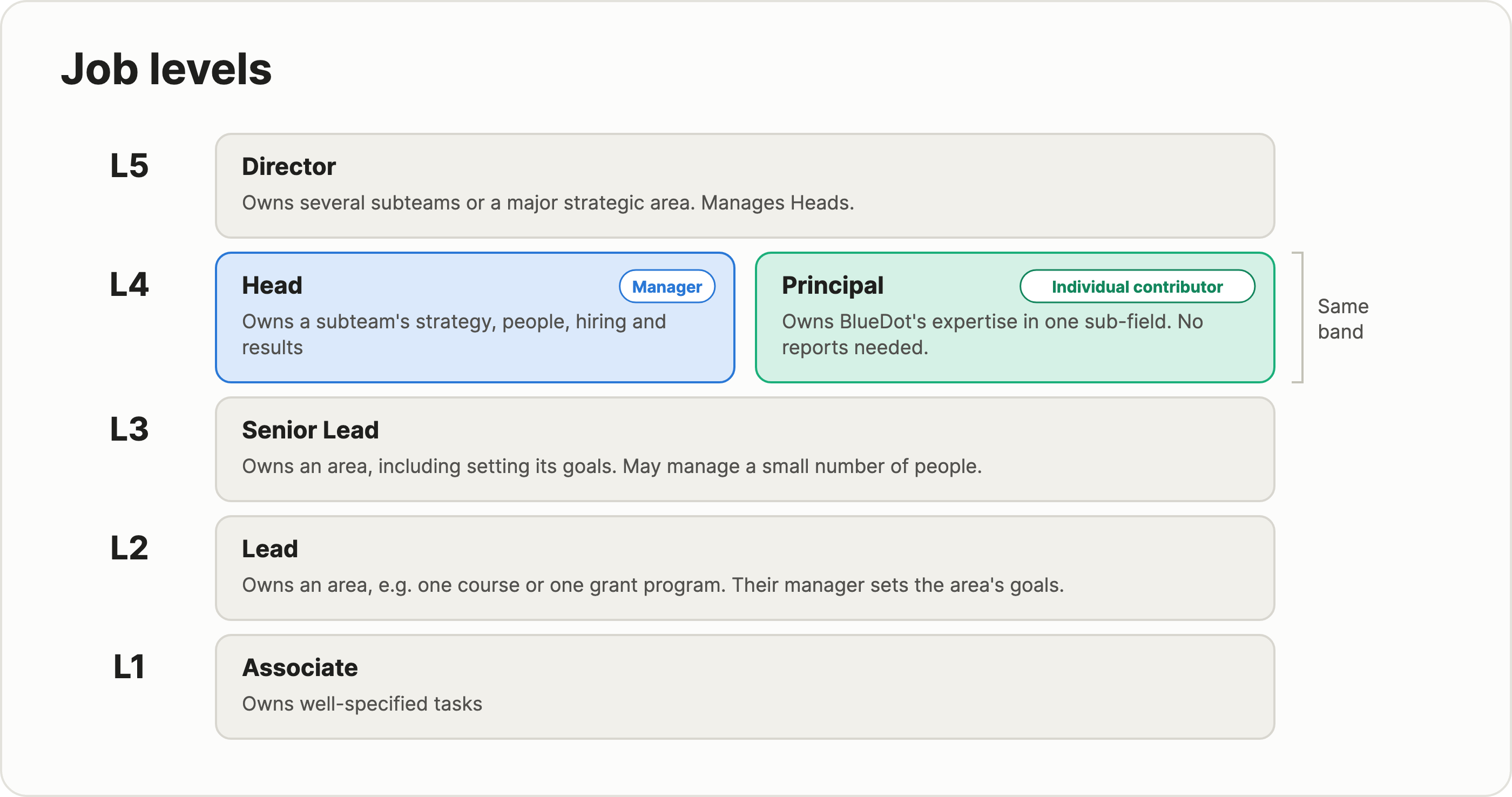
L1: Associate
Owns: small pieces of a larger project, or well-defined tasks set by someone else.
Autonomy: follows broad instructions and uses some judgement on how to do the work. Asks for help when blocked. Gets regular feedback.
Judgement: makes decisions where there is an established process to follow.
Typical roles: events support, community support
L2: Lead
Owns: an area and the projects in it, e.g. one course, one grant program or monthly bookkeeping. Their manager sets the area’s goals.
Autonomy: decides their goals with their manager, then works independently to achieve them.
Judgement: makes their own calls on small everyday decisions, and asks for their manager’s help when choosing between bigger trade-offs.
Typical roles: currently most of our core-team hires start here, e.g. new course leads, a finance operations lead or a software engineer
L3: Senior Lead
Owns: an area, including setting its goals. Leads complicated projects that involve other teams. May manage a small number of people, and coaches less experienced teammates.
Autonomy: works out what matters most in the area, turns it into a plan and drives it without being asked.
Judgement: makes hard trade-offs independently. Their manager regularly defers to their judgement.
Typical roles: experienced program, grants, operations and engineering leads
L4: Head
Owns: a subteam’s strategy, people, hiring and results. Manages leads and senior leads.
Autonomy: sets the subteam’s strategy and decides who works on what.
Judgement: regularly makes calls that affect their entire subteam.
Typical roles: e.g. Head of Courses, Head of Special Projects, Head of Operations
L4: Principal
Owns: BlueDot’s expertise in one sub-field, e.g. what research directions we should steer people towards within technical AI safety. Takes on problems where nobody has a clear answer yet. No reports needed.
Autonomy: decides what BlueDot should think and do in their area. Their subteam’s plans build on their work.
Judgement: BlueDot’s recognised expert on their area. Regularly makes calls that affect their entire subteam, and is starting to be known for their work outside BlueDot.
Typical roles: senior field strategists and talent investors
Principal is how someone who goes very deep in one area gets promoted without managing anyone. Heads and Principals in the same family share a salary band.
L5: Director
Owns: several subteams or a major strategic area. Manages Heads.
Autonomy: sets org-wide direction and long-term plans with the CEO.
Judgement: makes calls that affect the whole organisation.
Location factor
Your salary band depends on where you live. We start from the San Francisco salary band for your role and multiply it by a location factor.
San Francisco Bay Area: 1.0
Washington DC, London: 0.9
Anywhere else: 0.8
Why we do it this way
We want to incentivise people to work from SF, followed by London or DC. Our campus and primary hub is SF, with DC and London as our secondary hubs, and we think the company grows most effectively when the team is together in person.
We base this on which hubs we want people to be in and what other orgs like us pay there, rather than on cost of living.
The 0.9x factor fits what Kairos, MATS, Apollo, Quorum and 80k advertise in DC and London compared with SF.
0.8x for everywhere else is to keep the policy simple. It will be above market rate for some places and below for others, but we’d rather have something that is simple to apply without case-by-case calls.
If you move. If you move somewhere with a higher location factor (and we’ve agreed to the move), you go onto the new salary band from the day you move. If you move somewhere with a lower location factor, you keep the same pay but it won’t go up again until the new band has caught up with it.
Pay in other currencies. All of our salary bands are set in US dollars. If you’re paid in a different currency, we convert using the average exchange rate over the last 12 months, and we update that rate every April.
Benchmarking
Benchmarking is how we set the salary band for each level in each job family. We do it differently for different job families, because we compete for different people.
AI safety capacity-building
We compare ourselves with the organisations our candidates would otherwise join:
Grant-makers: Coefficient Giving, OpenAI Foundation, Longview Philanthropy
Top field-building orgs: Kairos, Constellation, MATS, 80,000 Hours, Quorum
We match the jobs they advertise to our levels, then for each level:
We collect their job ads for that level in San Francisco.
We take the middle of the posted salary range from each ad.
We take the 75th percentile of these figures, and this becomes the middle of our hiring range.
We build out the salary band from the middle of the hiring range.
Our hiring range runs from 0.85 to 1.00 of the reference point, so its middle is 0.925. We divide the 75th percentile by 0.925 to get the reference point.
We have an automation that saves these organisations’ job ads every week, along with other relevant ads on the 80,000 Hours job board.
Workplace, Business operations and Product
For these roles we compete with SF tech companies. We use Pave, which collects payroll data from thousands of tech companies. Our reference point is the 90th percentile base salary for the same job family and level in SF.
We aim this high for two reasons:
Tech companies also pay in equity and bonuses, which we don’t.
In these jobs the best people are worth far more than average ones, so we want to be able to hire from the top of the market.
We take the median of several Pave job families for each of our families, and match Pave’s levels to ours:
Product: Software Engineering, Product Management, Product Design
Business operations: Finance, Accounting & Financial Operations, HR, Talent Acquisition, Risk Management & Compliance, Business Operations
Workplace: Workplace employee experience, Office Management, Facilities
How we review pay
We review everyone’s pay twice a year, in April and October. Each review has two parts:
1. Market adjustment. The operations team redo benchmarking and update every salary band. In the unlikely event that a band goes down due to market adjustment, you will keep your current salary rather than adjusting downwards with the band.
2. Performance adjustment. Your manager evaluates your performance over the previous pay cycle against your scorecard. They then decide which step you belong in and where in the step you sit.
If after the market adjustment and the performance adjustment, your new proposed salary is higher than your current salary, you receive the new salary. If your new proposed salary is lower than your current salary, you retain your current salary. Your salary will never go down.
Pay can go above the top of your band (1.20 compa-ratio) only with CEO approval.
Promotions
Your manager can make a case for promotion at any time, using the next level’s definition. The CEO is required to confirm it (for now). We may need more structure here as BlueDot grows.
When you’re promoted, we set your pay within the hiring range of the new level, roughly where we’d put an external hire with your track record. If that would be less than a 5% raise, you get your current salary plus 5% instead.
Who decides what
Manager: When we’re hiring, the manager decides which level the role is, whether a candidate meets the bar for that level and whether we should make them an offer. At each pay review, they decide any pay changes and can propose promotions for the people they manage.
Operations: Works out the salary offer based on this policy. If the role doesn’t have a salary band yet, they set one.
CEO: Has to sign off on any new salary bands, any offer outside the hiring range, and promotions.
Chair or Board: Sets the CEO’s salary.
How will this evolve?
We’ll redo the benchmarking every April and October, and we expect to change parts of this policy as BlueDot grows.
If you think we’ve got something wrong, or you’ve solved one of these problems better at your own org, we’d love to hear about it. If you’re building your own team’s salary policy, feel free to copy any parts of this that are useful.
And if you’d like to work with us, check out our open roles or reach out!